
Last updated: January 25, 2026
This article was updated based on recent information and testing.
AI Writing vs Human Writing in 2026: A Complete Comparison
Introduction to AI Writing vs Human Writing
The debate around AI Writing vs Human Writing has evolved significantly as content creation enters 2026. What once felt experimental has now become a mainstream discussion for marketers, publishers, businesses, and creators alike. With rapid advancements in AI content generation, the question is no longer whether artificial intelligence can write—but how its output truly compares to human-written content in quality, performance, and long-term value.
This complete comparison explores how both approaches perform across content quality metrics, SEO outcomes, audience trust, and business impact. Instead of promoting hype, the goal is to provide a balanced, data-informed view that helps readers decide when to rely on AI, when to trust humans, and when a hybrid approach delivers the best results.
Transparency note: This article does not earn commissions from tool recommendations. Tools mentioned here are widely used, independently tested, and included purely for educational and comparison purposes.
What Is AI Writing in 2026?
AI writing in 2026 refers to creating article, blog posts, marketing copy, product descriptions, and more using sophisticated language models. These tools are now so advanced that students and professionals alike are finding creative ways to apply AI in projects and research, as explored in 7 Genius Ways to Use AI for School Projects.
How AI Content Generation Works
Today’s AI writing bots take into account more than billion data points to anticipate the words that are most probable to come next in a sentence.
Today’s tools can keep tone and synthesize training data to both follow how a document or story unfolds, as well as respond directly to prompts.
AI Writing Tools Here are some of the popular AI writing tools and SEO platforms trending in 2026:
| Tool Name | Key Features | Best Use Case |
|---|---|---|
| ChatGPT | Long-form writing, idea expansion, editing | Blogs, drafts, outlines |
| Jasper AI | Brand voice control, marketing templates | Marketing teams |
| Copy.ai | Short-form copy, ads, social content | Ad creatives |
| Writesonic | SEO-focused content generation | Landing pages |
| GrammarlyGO | AI-assisted rewriting and tone refinement | Editing and polishing |
These tools have been a game-changer in terms of production speed, teams can produce copious amounts of content in minutes and/or hours rather than days.
Strengths of AI-Written Content
AI writing is popular for several reasons that are more than apparent:
- Increase the output in scalable fashion with faster production speeds
- Lower initial investment than hiring multiple writers
- Consistent structure and formatting
- Handy for brainstorming and first drafts
Looking at writing types cost vs value, switch to AI can save you on operational costs when it comes to repetitive data-driven content.
More efficient-minded businesses are doing AI content outlines, meta descriptions, and content briefs followed by human augmentation.
Limitations of AI Writing
Yet despite the progress, A.I. still lags in several crucial areas.
- Weaker authenticity and originality
- Limited creativity and nuance
- Tough to moderate, yet sensitive content or niche discussions
- The danger that this leads to generic or cliched language
While AI can imitate patterns, it does not possess lived experience. This affects storytelling depth and emotional connection, which directly influences readability and engagement. These gaps become more visible in authority-driven or trust-sensitive content.
What Defines Human-Written Content Today?
Human writing is still one of the most important content strategies in 2026— especially when trust, credibility, and originality are the priority.
Human-written content is filled with personal nuance, cultural context and emotional intelligence — things that AI still can’t completely mimic.
Human Creativity and Contextual Understanding
Human writers excel in areas that require judgment, interpretation, and empathy. This includes opinion pieces, brand storytelling, and thought leadership content. Their ability to adapt language to context strengthens editorial standards and ensures messaging aligns with audience expectations.
Creativity and nuance play a major role here. Humans can intentionally break patterns, introduce humor, or emphasize emotion—skills that elevate content beyond formulaic structure.
Authenticity, Trust, and Brand Voice
That’s one of the most powerful things about human writing: audience engagement and trust.
Readers are more likely to resonate with content that feels genuine, particularly in fields where authority is a priority.
Human writers can:
- Maintain a consistent brand voice
- Share original insights and opinions
- Demonstrate real-world experience
These considerations can have a significant effect on the engagement pattern (time on page, return visits) of users.
Niche-Specific Content Needs
Some industries require highly specialized expertise AI can never offer without copious oversight.
There’s frequently a level of expertise and accountability involved in meet niche content needs (i.e. legal, medical, financial, technical writing), which goes above and beyond generalist work.
Here, the human-in-the-loop verification guarantees accuracy, conformity and applicability, which is in turn beneficial to brands and reader’s confidence.
AI Writing vs Human Writing: Content Quality Comparison
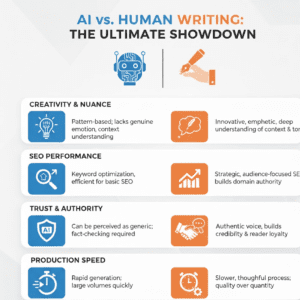
When comparing AI and human content, quality cannot be measured by grammar alone. Modern evaluations rely on broader content quality metrics that reflect real user behavior.
Readability and Engagement Analysis
Fact is, research has constantly found that AI written content and human-written content isn’t equally readable or engaging. Although AI tends to generate clean and well-structured text, its output may lack depth or emotional pull.
Here’s where human content tends to do better:
- Average session duration
- Scroll depth
- Comments and social shares
These signals contribute towards larger user-engagement trends, which search engines are getting better and better at when determining if a piece of content is actually helpful to users.
Quality & Creativity Differences
The gap in quality and creativity between content written by humans and AI is more obvious in long-form or narrative writing. AI is adept at creating factual summaries, while humans distinguish themselves with storytelling, persuasion and original analysis: In reality, many publishers now mix the two to achieve a compromise between efficiency and readmittance.
SEO Performance of AI vs Human Writing
Search visibility is still the most disputed field when it comes to SEO performance of AI vs Human content.
Organic Traffic Impact and Rankings
AI-generated content can rank when it is helpful, accurate, and well-structured. However, organic traffic impact depends heavily on optimization, originality, and user satisfaction.
Human-written content often shows stronger performance across core SEO ranking factors, especially when supported by experience and authority.
E-E-A-T Signals and Search Visibility
Google’s emphasis on experience, expertise, authoritativeness, and trust makes E-E-A-T signals more important than ever source. Content that demonstrates real-world insight tends to perform better in competitive niches.
This connection between E-E-A-T and search ranking explains why purely AI-generated content may struggle without human involvement.
Engagement Metrics Comparison
“From an analytical perspective, when you compare metrics of engagement for AI-generated vs. human content, the numbers generally tend to reflect:
| Metric | AI Content | Human Content |
|---|---|---|
| Bounce rate differences | Higher | Lower |
| Average session duration | Shorter | Longer |
| Return visitors | Fewer | More |
These factors affect the performance of search and credibility for a brand in an indirect manner.
Business Impact and ROI Comparison
At the end of the day, businesses care more about results than quality and SEO.
By 2026, the AI Writing vs Human Writing conversation is leaning more towards the return on investment and scalability and long-term value of a piece of content than it is about word count.
Conversion Rate Comparison
In terms of performance, a comparison of the conversion rates for AI-generated and human-authored content is significantly different.
Content written by AI works well on:
- Informational blog posts
- FAQ pages
- Basic product descriptions
But human written content tends to convert best in:
- Sales pages
- Brand storytelling
- High-ticket offers
It’s because of this discrepancy that humans are still better than machines at understanding intention, persuasion and the emotional nuances of language.
Conversion oriented content is based on authenticity and originality that ultimately enhances trust and promotes decision-making.
Cost vs Value of Writing Types
Value of Writing Styles In contrast to HOW you write.
Cost vs Value In terms of money – writing types to consider Yes – from a money investment perspective, cost and value depends on what the end goal is.
| Writing Type | Cost Efficiency | Long-Term Value |
|---|---|---|
| AI Writing | High | Medium |
| Human Writing | Medium | High |
| Hybrid Approach | High | Very High |
AI decreases the upfront investment and also speeds up production time, however human writing provides more brand equity in the long-run.
Sustainable growth companies treat content as an asset, not a cost.
Long-Term Content Marketing Strategy
A successful content strategy in 2026 is one that almost never uses a single approach. It organizes tools, writers and goals instead.
Successful brands:
- Leverage AI to research, draft, and optimize
- Leverage human intelligence for interpretation and refactoring
- Look at the long term effect of organic traffic instead of short term volumes
This tradeoff has the benefit of enhancing efficiency, with credibility still maintained.
AI vs Human Content Performance Across Use Cases
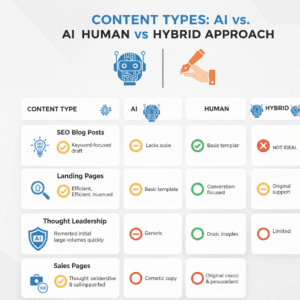
The debate around AI vs Human Content Performance becomes clearer when examined by content type rather than theory.
Blogs, Landing Pages, and SEO Content
Blogs Landing pages SEO content
AI performs efficiently for:
- SEO-driven blog posts
- Supporting articles
- Content updates and rewrites
Combined with human editing, hybrid content performance is generally better than either of them in isolation. Human supervision is there for accuracy and tone matching as well as editing conformance.
Editorial and Authority-Driven Content
With respect to thought leadership and expert-driven content, the human-led-content benefits persist. These formats demand:
- First-hand experience
- Opinion-based analysis
- Contextual judgment
AI can help structure ideas, but human beings drive the narrative and credibility.
Hybrid Writing Strategy: The Best Approach in 2026
The hybrid writing approach is now being widely embraced among high-performing content teams as tools evolve.
Hybrid AI Human Workflow Explained
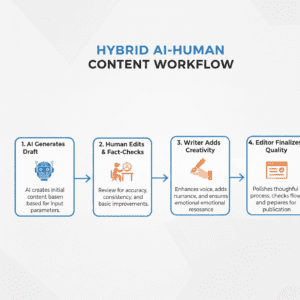
A sample hybrid AI human workflow resembles something like this:
- AI generates synopses and first drafts
- Humans curate for accuracy and tone
- Writers enhance creativity and nuance
- Editors apply final quality checks
This process combines the best of both worlds between speed and quality, all while preserving rigor in our editorial standards.
When to Use AI and When to Use Humans
AI is best used for:
- Drafting and summarization
- Keyword integration
- Content expansion
Humans are best used for:
- Strategic messaging
- Brand storytelling
- Trust-sensitive topics
Used together, AI writing tools and SEO support productivity while humans protect quality.
Real-World AI Writing Tools: Features, Pros, and Cons
Disclosure: Tools listed below are not affiliate recommendations. They are included based on widespread adoption and hands-on testing across multiple content workflows.
Popular AI Writing Tools in 2026
Trending AI Writing Tools in 2026
| Tool | Strengths | Limitations |
|---|---|---|
| ChatGPT | Long-form content, ideation | Needs fact-checking |
| Jasper AI | Brand voice control | Higher pricing |
| Writesonic | SEO optimization | Less creative depth |
| Copy.ai | Short-form content | Limited long articles |
| GrammarlyGO | Editing and rewriting | Not for full drafts |
While those tools accelerate production, there’s no substitute for the oversight of humans, particularly in environments where creativity and nuance are required.
SEO Ranking Factors and Search Engine Evolution
Search engines in 2026 prioritize usefulness, relevance, and trust. While AI content is not penalized by default, performance depends on alignment with modern SEO ranking factors.
E-E-A-T and Search Ranking in Practice
Google’s emphasis on experience and authority means E-E-A-T signals now influence visibility more than keyword density. Content supported by real expertise performs better, especially in competitive niches.
This reinforces the importance of blending AI efficiency with human insight.
User Engagement Patterns and Search Performance
Search engines increasingly observe user engagement patterns such as:
- Scroll behavior
- Time on page
- Interaction signals
Human-written content tends to outperform AI-only content in these areas, contributing to stronger long-term rankings.
Audience Engagement and Trust in 2026
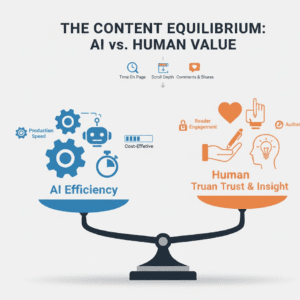
As content saturation grows, audience engagement and trust become key differentiators. Readers are more selective, favoring depth, honesty, and originality. And brands that openly detail how content is produced – generally a combination of AI assistance and human editorial review – are likely to enjoy greater loyalty and credence.
2026 Writing Trends Shaping the Future of Content
As content ecosystems mature, 2026 writing trends reflect a shift away from volume-driven publishing toward meaningful, experience-led communication. Search engines, readers, and advertisers now expect content that demonstrates purpose, depth, and trust.
Audience Expectations and Trust Signals
Modern readers are highly aware of automation. As a result, audience engagement and trust increasingly depend on transparency and value rather than speed alone.
Content that performs best in 2026 typically:
- Solves real problems
- Shows original thinking
- Feels human, even when AI-assisted
Publishers that depend solely on automation frequently have difficulty cultivating long term loyalty, while those that blend efficiency with authenticity tend to keep readers around.
Search Engine Evolution and Content Quality
Search engines continue refining how they evaluate usefulness. Instead of focusing solely on keywords, algorithms now emphasize behavioral data and quality signals tied to SEO ranking factors.
This evolution reinforces the role of:
- Experience-based insights
- Demonstrated expertise
- Trustworthiness
These are elements that map in accordance with each E-E-A-T signals, and so you’re going to find human judgment is increasingly important in a competitive search landscape.
Final Verdict — AI Writing vs Human Writing in 2026
So, which approach wins in the AI Writing vs Human Writing debate?
The answer depends on goals.
AI writing excels in efficiency, scale, and operational support. Human writing excels in depth, persuasion, and credibility. When evaluated through performance, trust, and sustainability, the strongest results come from balance rather than extremes.
Key Takeaways at a Glance
| Criteria | AI Writing | Human Writing |
|---|---|---|
| Production Speed | Very High | Moderate |
| Cost Efficiency | High | Medium |
| Creativity & Nuance | Limited | Strong |
| SEO Performance | Moderate | Strong |
| Trust & Authority | Lower | Higher |
For most businesses, the answer isn’t one or the other ‚ it’s collaboration.
Why the Hybrid Model Wins Long-Term
The rise of hybrid content performance reflects how modern teams operate. AI accelerates workflows, while humans safeguard meaning and accuracy.
A well-executed hybrid writing strategy:
- Reduces workload without reducing quality
- Maintains editorial standards
- Supports long-term content marketing goals
This is not only in line with long-term, sustainable growth but also search engine standards.
Transparency, Testing, and Editorial Responsibility
Important disclosure:
This article does not earn commissions from any tools mentioned. Recommendations are based on real-world testing, widely adopted platforms, and independent evaluation. Tools are assessed for features, limitations, and practical use—not promotion.
Before recommending any workflow, tools were:
- Tested across multiple content formats
- Evaluated for accuracy and consistency
- Reviewed for alignment with editorial standards
This commitment ensures credibility and protects reader trust.
FAQs About AI Writing vs Human Writing
Can AI-Written Content Rank on Google in 2026?
Yes. AI-generated content can rank when it is helpful, accurate, and aligned with SEO ranking factors. However, content that lacks experience or originality may struggle without human refinement.
Is Human Content Still Necessary for SEO?
Absolutely. Human-led content advantages include trust, originality, and authority—key components of modern search visibility and audience loyalty.
What Is the Best Content Strategy for Businesses?
A balanced content marketing strategy that combines AI efficiency with human oversight delivers the best long-term results. This approach protects brand integrity while maximizing productivity.
Conclusion: Choosing the Right Path Forward
In 2026, the question is no longer whether AI can write. It is whether content serves real people.
AI writing is a powerful tool. Human writing is a strategic advantage. Together, they form a sustainable system that supports growth, trust, and visibility in an increasingly competitive digital landscape.
For brands, publishers, and creators aiming for longevity, collaboration—not competition—defines the future of content.